
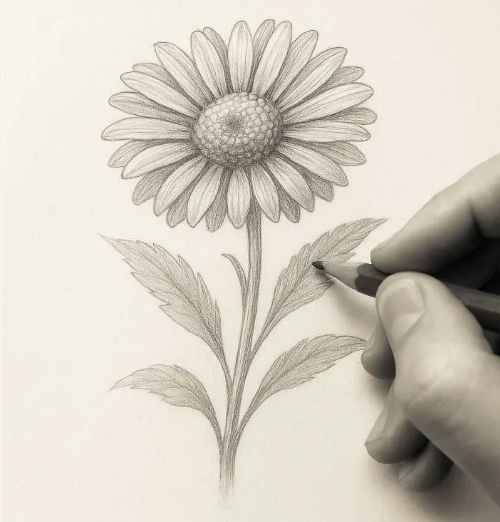
Introduction to Floral Sketching
Art has always been a way for humans to express emotions, ideas, and imagination. Among all artistic subjects, flowers remain one of the most loved and approachable forms for beginners. When someone first searches for how to draw a flower, they are usually looking for something simple, relaxing, and achievable without professional training. That is exactly what floral sketching offers.
Flowers naturally come with soft curves, repeating patterns, and organic shapes, making them ideal for learning basic drawing skills. You don’t need perfection—you just need observation and patience. Even a rough sketch can look beautiful when drawn with care and creativity.
As you begin this journey, remember that every artist started with simple lines and shapes. Mastering how to draw a flower is less about talent and more about consistent practice and understanding basic structure. Once you grasp the fundamentals, you can easily experiment with different styles and designs.
This guide will walk you through everything in a calm, step-by-step way so you can enjoy the process instead of feeling pressured.
Why Flowers Are the Easiest Subject for Beginners

Flowers are often recommended as the first subject for new artists because they are forgiving and flexible in structure. Unlike human faces or animals, flowers do not require exact proportions to look appealing.
When you explore how to draw a flower, you’ll notice that even simple circles and curves can resemble real blossoms. This makes the learning process less stressful and more enjoyable.
Another reason flowers are easy is their variety. You can draw roses, daisies, tulips, or even imaginary flowers without worrying about strict rules. Each petal can be slightly different, and it still looks natural.
Most importantly, drawing flowers helps you develop hand control and observation skills without overwhelming complexity. It builds confidence gradually, which is essential for any beginner artist.
Tools and Setup for Floral Drawing
Before starting your sketching journey, setting up basic tools is important. You don’t need expensive materials to begin. Simplicity works best.
A standard pencil, eraser, and sketchbook are enough for learning. As you improve, you can add shading pencils or colors to enhance your artwork. A smooth surface also helps your hand move freely.
When practicing how to draw a flower, make sure your pencil is lightly sharpened so you can create soft outlines. Heavy lines at the beginning can make corrections difficult later.
Comfort is also important. Sit in a well-lit area where you can clearly see your paper. Good lighting helps you notice small details, which improves your drawing accuracy over time.
Step-by-Step Process of Drawing Flowers
Understanding structure is the heart of floral sketching. Most flowers follow a circular or radial pattern, which makes them easier to construct.
To begin, lightly sketch a small circle in the center of your page. This will act as the core of your flower. Around it, draw oval shapes to represent petals. These shapes don’t need to be perfect—natural variation adds beauty.
Slowly refine each petal, adjusting curves and spacing. Add a stem by drawing a slightly curved line downward. Then include leaves on both sides.
At this stage, you are already practicing how to draw a flower without realizing it. The key is not rushing. Let each line guide the next one naturally.
Once the structure feels complete, darken the final outlines and erase unnecessary guide marks. This gives your flower a clean and finished look.
Understanding Flower Structure and Balance
Every flower has a unique design, but they all share basic structural elements. Learning these helps you create more realistic sketches.
CIRCLEAREA=πr2CIRCLE AREA = \pi r^2CIRCLEAREA=πr2
The circular nature of flowers is what makes them visually balanced. Petals usually spread evenly from the center, forming a radial symmetry that feels natural to the human eye.
When practicing how to draw a flower, understanding this symmetry is extremely helpful. It allows you to place petals evenly without overthinking proportions.
Leaves also play an important role in balance. They often grow in opposite directions, creating visual harmony. The stem acts as the connecting structure, grounding the entire design.
By observing real flowers, you begin to notice patterns that can be applied to your sketches. This improves both accuracy and creativity.
Table: Comparing Flower Drawing Styles
| Style Type | Difficulty Level | Detail Required | Best For Beginners |
|---|---|---|---|
| Simple Sketch | Easy | Low | Yes |
| Realistic Flower | Medium | High | Moderate |
| Cartoon Style | Easy | Medium | Yes |
| Mandala Flower | Hard | Very High | No (initially) |
This table helps you decide which approach suits your comfort level while learning how to draw a flower.
Shading and Depth Techniques for Realism
- how to draw a flower
Shading is what transforms a flat sketch into a lifelike drawing. It adds depth, dimension, and realism.
Start by identifying where light would naturally fall on your flower. The opposite side should be slightly darker. This contrast creates a 3D effect.
Soft shading works best for beginners. Use light pencil pressure and gradually build darker tones. Blending can be done using fingers or blending tools.
When practicing how to draw a flower, shading should feel like layering rather than coloring. Each layer adds depth without overpowering the sketch.
Petals closer to the center often appear darker, while outer petals are lighter due to light exposure.
Practice Routine for Steady Improvement
Consistent practice is the most effective way to improve your drawing skills. Even short daily sessions can create noticeable progress.
Begin with basic shapes like circles and ovals. These improve hand control. Then move on to petal repetition exercises where you draw multiple petals in different sizes.
Gradually, try combining all elements into a full flower drawing. This helps reinforce everything you’ve learned about how to draw a flower.
Practicing regularly trains your brain to understand shapes better, making future sketches faster and smoother.
The key is not perfection but repetition and patience.
Creative Variations to Explore Floral Art
Once you feel comfortable with basics, you can experiment with creative styles. Flowers offer endless possibilities for imagination.
You can design fantasy flowers with unique petal shapes or combine multiple flowers into a bouquet. Adding butterflies, leaves, or vines can make your artwork more dynamic.
Color also plays a big role. Soft pastels create a calm look, while bold colors make the artwork more vibrant.
Exploring creativity helps deepen your understanding of how to draw a flower beyond basic structure and into artistic expression.
Common Mistakes Beginners Should Avoid
Many beginners struggle with similar issues when starting out. One common mistake is pressing too hard with the pencil, which makes corrections difficult.
Another mistake is trying to make everything perfect from the start. Flowers are naturally imperfect, and that is what makes them beautiful.
Some learners also skip basic shapes and jump directly into complex designs. This often leads to frustration.
When learning how to draw a flower, patience is more important than speed. Allow your skills to develop gradually.
FAQs About Flower Drawing
What is the easiest flower to draw?
Daisies are often the easiest due to their simple petal structure.
How long does it take to learn flower drawing?
With regular practice, noticeable improvement can happen within a few weeks.
Do I need shading skills to start?
No, shading can be learned later after mastering basic shapes.
Can kids learn flower drawing easily?
Yes, it is one of the best beginner-friendly art activities for children.
What should I practice daily?
Basic shapes, petals, and simple full flowers.
Conclusion
Learning art is a journey that grows with patience and practice. Flowers are one of the best subjects to begin this journey because they are simple yet expressive. As you continue practicing, you will slowly gain confidence and creativity.
Understanding how to draw a flower is not about copying perfectly but about observing nature and expressing it in your own way. Each sketch you make improves your control, imagination, and artistic sense.
Keep your practice consistent, stay relaxed, and enjoy the process. Over time, your simple sketches will turn into beautiful floral artwork that reflects your growth as an artist.