

When you feel like drawing but cannot decide what to sketch, a list of random ideas can turn a blank page into a creative playground. Drawing does not always require a detailed plan or advanced artistic skills. Sometimes, the best sketches begin with ordinary objects, simple shapes, funny characters, or unusual combinations of ideas. These small prompts can help you practice observation, experiment with styles, and enjoy the process without worrying about making every line perfect.
The following collection includes 50 things to draw for different moods and skill levels. Some ideas are quick doodles, while others can become detailed illustrations. You can use a pencil, pen, colored pencils, markers, watercolor, or a digital drawing application. Pick any idea that catches your attention and give yourself permission to interpret it in your own way.
Why Random Drawing Ideas Are Useful
Having a collection of drawing prompts can make creative practice easier. Instead of spending ten minutes wondering what to draw, you can immediately choose an object or concept and start sketching. This is particularly useful for beginners who are still developing confidence.
Random prompts also encourage experimentation. A simple cup can become a realistic study, a cartoon character, a futuristic object, or part of a larger scene. The same subject can look completely different depending on the artist’s perspective, medium, and imagination.
Another advantage is that varied subjects help develop different artistic skills. Faces improve proportion practice, plants introduce organic shapes, buildings develop perspective, and everyday objects teach light and shadow.
50 Creative Things to Draw
| No. | Drawing Idea | Skill or Style to Try |
|---|---|---|
| 1 | Cozy coffee cup | Shading |
| 2 | Sleeping cat | Simple character art |
| 3 | Mountain cabin | Landscape |
| 4 | Houseplant | Botanical sketch |
| 5 | Old key | Line drawing |
| 6 | Moon and clouds | Atmospheric art |
| 7 | Favorite snack | Food illustration |
| 8 | Backpack | Object study |
| 9 | Small robot | Character design |
| 10 | Mushroom village | Fantasy art |
| 11 | Pair of sneakers | Perspective |
| 12 | Friendly ghost | Cartoon drawing |
| 13 | Ocean wave | Motion and texture |
| 14 | Vintage camera | Detail practice |
| 15 | Owl | Animal sketch |
| 16 | Tiny castle | Fantasy landscape |
| 17 | Bicycle | Perspective |
| 18 | Candle | Light and shadow |
| 19 | Dragon egg | Fantasy illustration |
| 20 | Rainy window | Mood drawing |
| 21 | Sunflower | Botanical detail |
| 22 | Astronaut | Figure design |
| 23 | Treehouse | Imaginative scene |
| 24 | Ice cream cone | Cute illustration |
| 25 | Lighthouse | Seascape |
| 26 | Fox | Animal drawing |
| 27 | Treasure chest | Texture practice |
| 28 | Bookshelf | Interior sketch |
| 29 | Planet system | Creative design |
| 30 | Streetlamp | Night scene |
| 31 | Butterfly | Symmetry |
| 32 | Magical door | Fantasy art |
| 33 | Park bench | Environment sketch |
| 34 | Pair of glasses | Still life |
| 35 | Tiny dragon | Character art |
| 36 | Autumn leaf | Texture |
| 37 | Hot-air balloon | Composition |
| 38 | Friendly monster | Cartooning |
| 39 | Old train | Mechanical details |
| 40 | Teapot | Still life |
| 41 | Desert cactus | Nature drawing |
| 42 | Fairy house | Fantasy |
| 43 | Window with curtains | Interior detail |
| 44 | Penguin | Cute character |
| 45 | Record player | Vintage illustration |
| 46 | Cloud-shaped creature | Imagination |
| 47 | Forest path | Perspective |
| 48 | Pirate ship | Adventure scene |
| 49 | Tiny bakery | Architecture |
| 50 | Imaginary animal | Character creation |
Easy Everyday Objects to Sketch
Everyday objects are excellent starting points because they are familiar and easy to observe. Try drawing a coffee mug, backpack, sneaker, key, pair of glasses, or teapot. Rather than simply outlining the object, look at its proportions, curves, edges, and shadows.
For an extra challenge, arrange several objects together and create a still-life composition. You could place a cup beside a book, a plant, and a pair of glasses. This turns a basic sketch into a study of composition and overlapping shapes.
These simple things to draw can also be completed quickly, making them suitable for short daily drawing sessions.
Cute and Funny Drawing Prompts
Cute characters are popular because they allow artists to exaggerate expressions and proportions. A sleeping cat, friendly ghost, tiny dragon, penguin, or funny monster can be drawn with basic shapes such as circles, ovals, triangles, and curved lines.
Try changing the character’s expression to create personality. A small change in the eyes or mouth can make a character look surprised, excited, sleepy, confused, or cheerful.
You can also combine unrelated objects with characters. Imagine a tiny monster living inside a teacup or a penguin carrying an oversized backpack. Combining familiar subjects in unexpected ways can produce original doodle concepts.
Nature-Inspired Drawing Ideas
Nature provides an almost endless collection of subjects. Leaves, flowers, mountains, clouds, mushrooms, butterflies, waves, and animals all offer different textures and shapes to explore.
A sunflower can be used to practice repeated patterns and organic forms. A mountain scene can introduce foreground, middle ground, and background. An ocean wave can help you experiment with flowing lines and movement.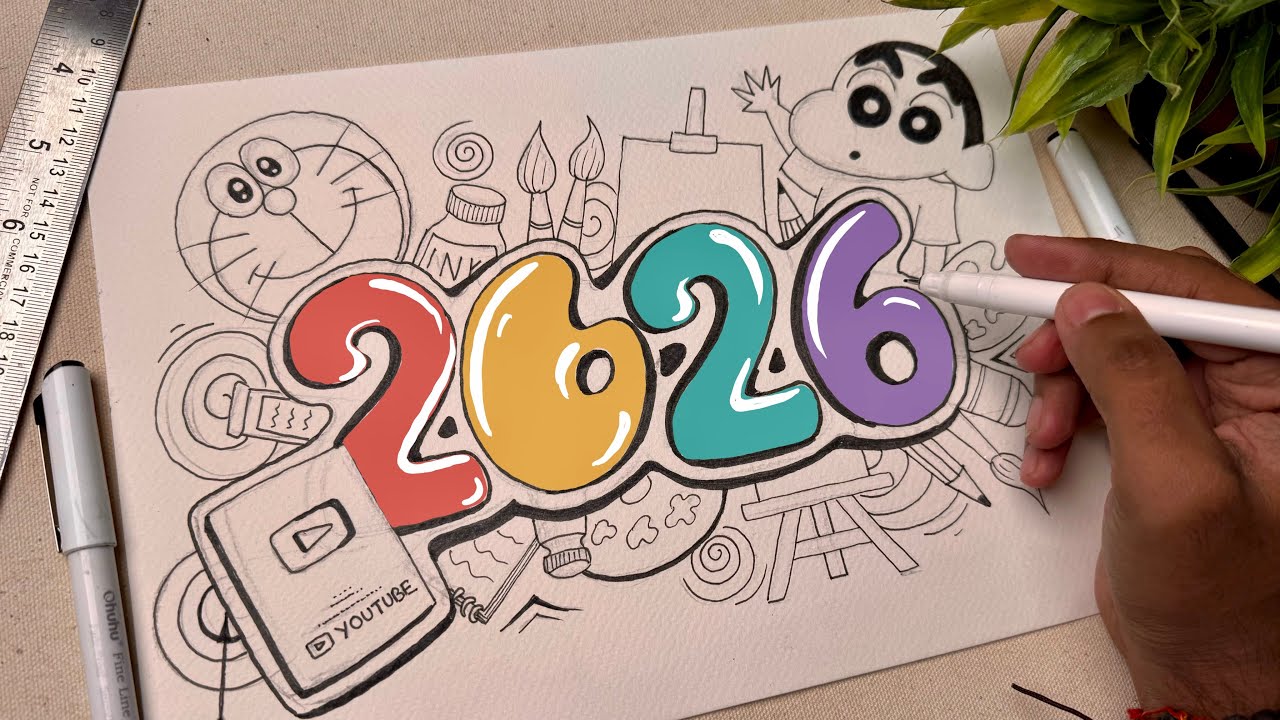
For beginners, natural subjects are especially helpful because they do not need to look perfectly symmetrical. You can focus on observation rather than mathematical precision.
Fantasy Ideas for More Imagination
If realistic drawing feels limiting, move into fantasy. Draw a magical door, tiny castle, fairy house, treasure chest, dragon egg, or mushroom village. Fantasy prompts give you freedom to invent details rather than reproduce something exactly.
One effective exercise is to start with a simple object and transform it. A normal door could lead to another planet. A tree could become a giant home. A small island could contain an entire miniature kingdom.
When developing fantasy scenes, think about scale. Making one object unusually large or tiny can instantly make an illustration more interesting.
Things to Draw When You Want a Challenge
Some subjects require more attention to perspective, proportion, or detail. Bicycles, old trains, cameras, buildings, and interior scenes are useful for developing technical skills.
A bicycle, for example, contains circles, overlapping structures, thin lines, and perspective challenges. An old train introduces mechanical shapes and repeating windows. A bookshelf can help you practice straight lines, depth, and object placement.
Do not try to complete every detail immediately. Begin with basic shapes, establish the overall proportions, and gradually add smaller elements.
Turn Simple Sketches Into Bigger Scenes
A single object does not have to remain alone on the page. Expanding a basic prompt into a scene can make drawing more engaging. A lighthouse can become part of a stormy coastline. A streetlamp can sit beside a quiet nighttime road. A park bench can become the focal point of an autumn landscape.
This approach teaches composition because you must decide where objects belong and how they interact with one another.
Try asking simple questions while developing a scene: What is happening here? What time of day is it? Who might live in this place? What is in the background? These questions can turn a basic doodle into a visual story.
How to Practice With Drawing Prompts
You do not need a complicated routine to improve. Choose one prompt and spend a fixed amount of time exploring it. A quick sketch can focus on shape, while a longer session can include shading, texture, color, and background details.
A useful practice approach is:
- Start with a loose sketch instead of trying to make perfect lines.
- Study the basic shapes before adding details.
- Try the same subject from two different viewpoints.
- Experiment with both realistic and cartoon styles.
- Keep older sketches so you can compare your progress later.
The goal is consistency rather than perfection. Even a short drawing session can help you become more comfortable with lines, proportions, composition, and visual ideas.
Make Your Own Drawing Challenges
Once you have worked through these prompts, create your own combinations. Pick one animal, one object, and one environment, then combine them into a single illustration. For example, you could draw a fox inside a tiny bakery or an astronaut exploring a mushroom forest.
Another option is to choose a random household object and redesign it as a fantasy item. A teapot could become a spaceship, a key could unlock a magical world, or a backpack could belong to an adventurous robot.
Creating your own prompts prevents your practice from becoming repetitive and encourages creative problem-solving.
Choosing the Right Drawing Style
There is no single correct way to interpret things to draw. A beginner may prefer simple line art, while another artist may enjoy realistic shading or colorful digital illustrations.
You can explore several styles, including:
- Line art: Focus on clean outlines and shapes.
- Doodle art: Use playful patterns and spontaneous ideas.
- Cartooning: Exaggerate expressions and proportions.
- Realistic sketching: Concentrate on observation, light, and texture.
- Digital illustration: Experiment with layers, brushes, and color.
Trying different approaches can reveal which techniques you enjoy most. It can also help you avoid getting stuck in one visual style.
Use Random Prompts to Beat Creative Blocks
Creative blocks often happen when you place too much pressure on yourself to create something impressive. Random prompts remove some of that pressure because the subject is already selected.
Instead of asking whether your sketch will look professional, concentrate on completing the idea. A strange or imperfect drawing can still teach you something about shape, perspective, expression, or composition.
Keep a notebook or digital list of things to draw whenever inspiration appears. When you have no idea what to sketch, choose one without overthinking it.
Conclusion
A blank page does not have to be intimidating. With 50 drawing prompts ranging from everyday objects and cute characters to landscapes, fantasy scenes, and imaginative creatures, you can always find a starting point. The most valuable part of drawing is not creating a flawless picture but learning to observe, experiment, and communicate ideas visually.
Use these things to draw as starting points rather than strict instructions. Change the subjects, combine unrelated concepts, switch between realistic and cartoon styles, and develop your own scenes. With regular practice and curiosity, even the simplest prompt can become an opportunity to create something personal and original.