

Boredom can be a great excuse to pick up a pencil and start creating. You do not need advanced drawing skills, expensive art supplies, or a complicated idea to make something interesting. A blank page can become a collection of doodles, a simple landscape, a funny character, or an imaginative scene within a few minutes. The best things to draw when bored are often simple enough to begin immediately but flexible enough to let your creativity develop naturally.
Drawing also gives you an opportunity to experiment without worrying about making everything perfect. You can use a pencil, pen, colored markers, crayons, or a digital drawing app. Whether you have five minutes or an entire afternoon, there are plenty of subjects that can turn idle time into creative practice.
Start With Simple Everyday Objects
One of the easiest ways to overcome a creative block is to draw something already around you. Look at your desk, bedroom, kitchen, or outdoor surroundings and choose one ordinary object. A coffee mug, pair of glasses, houseplant, backpack, headphones, lamp, or water bottle can become a useful sketching subject.
Everyday objects are particularly helpful because you can study their shape directly. Begin with basic outlines before adding smaller details, shadows, and textures. For example, a mug can be created from an oval, two curved lines, and a handle. Once you become comfortable, try drawing the same object from different angles.
This approach makes things to draw when bored both accessible and practical because you are practicing observation while creating something recognizable.
Try Cute and Simple Doodles
Doodling is ideal when you want something relaxing rather than technically challenging. Start with small drawings such as stars, clouds, flowers, hearts, moons, leaves, faces, tiny animals, or smiling objects. You can combine several doodles to create a complete page.
Another fun idea is to give ordinary objects personalities. Draw a smiling slice of toast, a sleepy moon, a tiny plant wearing sunglasses, or a coffee cup with an expressive face. These drawings do not have to follow realistic proportions.
If you are searching for things to draw when bored that require very little preparation, cute doodles are a natural starting point. They can also become stickers, journal decorations, greeting-card illustrations, or digital icons.
Explore Nature-Inspired Sketches
Nature provides an almost unlimited collection of drawing subjects. Look at leaves, flowers, trees, mountains, seashells, birds, butterflies, or clouds for inspiration. You can draw a single leaf in detail or create a small outdoor scene containing several elements.
Try drawing flowers with different petal shapes and arrangements. You can also sketch a tree during different seasons or create a landscape using only simple lines. If you prefer something more imaginative, combine real natural elements with fantasy details, such as glowing flowers or floating islands.
Nature sketches are useful because they encourage you to pay attention to curves, textures, patterns, light, and proportion while keeping the subject familiar.
Make Patterns and Repeating Designs
If you do not have a specific subject in mind, fill a page with patterns. Repeated shapes can produce surprisingly attractive artwork without requiring realistic drawing skills.
You might combine circles, triangles, waves, spirals, leaves, dots, stars, and geometric lines. Divide a page into sections and create a different pattern in each area. Alternatively, begin with one small shape and repeat it until the page develops into a larger design.
Here is a quick guide to different ideas and the skills they can help develop:
| Drawing idea | Difficulty | Main skill practiced |
|---|---|---|
| Simple doodles | Easy | Creativity and line control |
| Everyday objects | Easy | Observation and proportion |
| Nature sketches | Easy–Medium | Shape and texture |
| Geometric patterns | Easy | Precision and repetition |
| Cartoon characters | Medium | Expression and posing |
| Landscapes | Medium | Composition and depth |
| Fantasy scenes | Medium | Imagination and visual storytelling |
Pattern drawing is particularly useful when you want things to draw when bored that can continue for as long as you want. There is no fixed endpoint, so you can keep adding details whenever inspiration appears.
Create Your Own Cartoon Characters
Designing a character gives you more freedom than copying an existing image. Start with a simple head shape and experiment with eyes, eyebrows, hairstyles, clothing, and expressions. You can make the character cheerful, mysterious, adventurous, sleepy, or completely unusual.
Next, think about the character’s personality. Perhaps they are a tiny explorer carrying an oversized backpack or a robot that loves gardening. Small details can make a basic sketch feel like part of a story.
Try drawing the same character with several expressions. This is a useful exercise for understanding facial features and emotional communication. You can also experiment with different poses, outfits, and accessories.
Character creation is one of the most enjoyable things to draw when bored because the subject can evolve as you draw rather than being decided completely in advance.
Draw Small Scenes Instead of Single Objects
If individual objects feel too easy, connect them into a scene. Instead of drawing only a house, sketch a small neighborhood around it. Add a road, trees, clouds, windows, bicycles, fences, and people.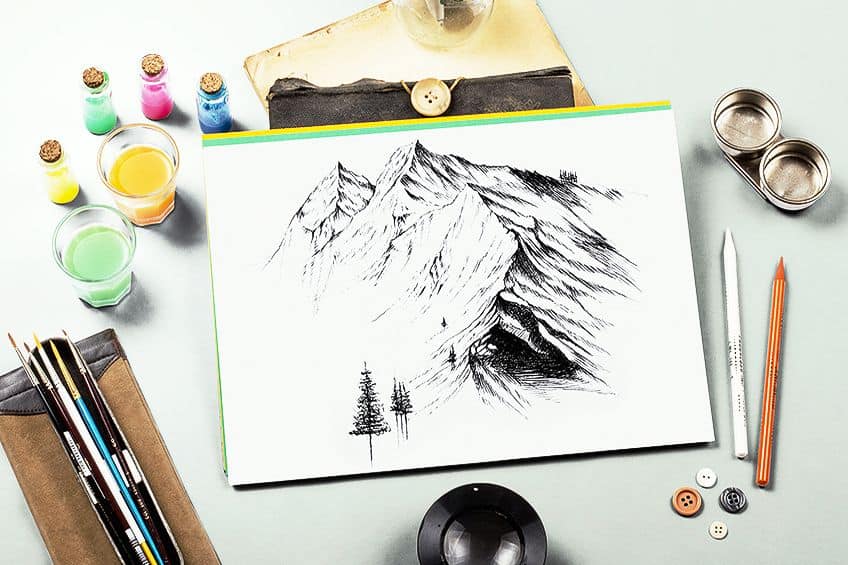
You can also create indoor scenes such as a cozy bedroom, reading corner, artist’s desk, or small café. Focus on arranging objects rather than making every detail perfect.
For beginners, scene drawing is a useful introduction to composition. It teaches you how objects relate to one another in space and how foreground, middle ground, and background can create depth.
Use Imagination With Fantasy Ideas
Your drawing does not have to represent something that exists in real life. Fantasy subjects allow you to ignore ordinary rules and experiment freely.
Consider drawing a castle on a floating island, a tiny village inside a tree, an underwater library, a magical doorway, or a city on another planet. You can mix familiar objects with unexpected environments to create something unique.
A good technique is to combine two unrelated ideas. Imagine a cat astronaut, a dragon running a bakery, or a robot exploring an ancient forest. These combinations can quickly generate fresh concepts when you feel stuck.
For anyone collecting things to draw when bored, imaginative prompts are especially valuable because there is no single correct result.
Practice Faces and Expressions
Faces provide endless opportunities for quick sketches. Begin with simple circles and guidelines, then experiment with eyes, noses, mouths, eyebrows, and hairstyles. Instead of trying to create a perfect realistic portrait, focus on expressions.
Draw a face showing happiness, surprise, confusion, anger, excitement, nervousness, or boredom. Exaggerating facial features can make the exercise more entertaining.
You can also create a page of different eyes or hairstyles. This helps you understand how small changes affect the overall appearance of a character.
Turn Random Shapes Into Drawings
Another creative exercise starts with randomness. Draw several unrelated shapes, squiggles, curves, or lines without deciding what they represent. Then look at the page and turn those marks into recognizable objects.
A curved line might become a wave, snake, road, or smile. A circle could become a planet, balloon, face, or fruit. This method removes the pressure of deciding what to draw first.
It is also a useful reminder that creative work can begin with experimentation rather than a detailed plan. Some of the most interesting things to draw when bored can emerge from marks that initially seem meaningless.
Make a Personal Drawing Challenge
When you want a more structured activity, create a small drawing challenge. Choose a theme and make several sketches around it. For example, you could draw five animals, seven types of flowers, different fantasy doors, or one imaginary creature each day.
Keep the drawings small so the activity does not become overwhelming. You can also set a simple time limit and stop when it ends. The goal is to practice creativity rather than produce a perfect finished illustration.
Some quick challenge ideas include:
- Draw the same object from three angles.
- Create a character using only circles and squares.
- Design an imaginary room.
- Turn random shapes into recognizable objects.
- Draw a scene using only black-and-white lines.
These exercises can make things to draw when bored feel more like a game than a traditional art assignment.
Experiment With Different Drawing Styles
You do not have to stick to one artistic style. Try realistic sketches one day and cartoon drawings the next. You could experiment with minimal line art, comic-style illustrations, geometric art, abstract shapes, or detailed pencil shading.
Changing styles can reveal which techniques you enjoy most. It also prevents drawing practice from becoming repetitive.
Try using different tools as well. A pencil encourages shading, while a fine pen emphasizes clean outlines. Colored pencils and markers can introduce layering and color combinations. Even ordinary stationery can produce interesting results when used creatively.
Keep a Creative Sketchbook
A sketchbook can make spontaneous drawing easier because you always have a place to collect ideas. Do not worry about keeping every page neat. Some pages can contain polished drawings while others can contain rough experiments, notes, patterns, or unfinished characters.
When you run out of ideas, look through older pages and develop one unfinished concept. Add a background, change the character, introduce new objects, or redraw it in another style.
Over time, your sketchbook becomes a record of your creative progress. It can also help you notice which subjects, techniques, and visual styles you naturally enjoy.
Conclusion
There are countless things to draw when bored, and the best choice depends on your mood and skill level. Simple objects and doodles are excellent for quick sessions, while landscapes, characters, patterns, and fantasy scenes offer more room for exploration. You can also turn random shapes into artwork or create small personal challenges to keep drawing interesting.
The most important part is to begin without expecting perfection. A blank page does not need to become a masterpiece. It simply needs your first line. Once you start experimenting, boredom can quickly turn into an opportunity to practice observation, develop imagination, and discover new creative ideas.