
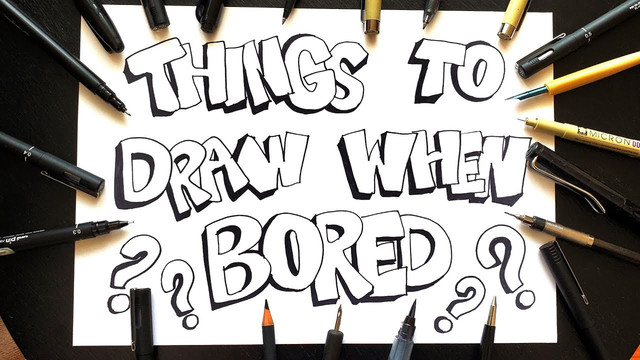
When boredom strikes, drawing can turn a few quiet minutes into a creative activity. You do not need advanced artistic skills, expensive supplies, or a complicated subject to begin. Some of the best things to draw when bored are surprisingly simple, such as patterns, tiny objects, expressive faces, plants, or imaginative shapes. The goal is not necessarily to create a perfect picture. Instead, drawing gives your attention something enjoyable to focus on while allowing your imagination to develop naturally.
Simple doodling is an excellent starting point because there are almost no rules. Pick up a pencil, pen, or marker and fill a page with circles, waves, stars, leaves, spirals, geometric shapes, and abstract lines. You can combine several basic forms to create decorative borders or unusual patterns. This kind of freehand sketching can also help you discover drawing ideas without putting pressure on yourself to produce a finished artwork.
Draw Everyday Objects Around You
Your surroundings can provide an endless supply of subjects. Look around your room and choose something that normally seems uninteresting. A coffee mug, pair of headphones, desk lamp, water bottle, backpack, book, or pair of shoes can become a useful sketching exercise.
Instead of simply copying the object, experiment with different perspectives. Draw it from above, from the side, or from a low angle. Try making a close-up drawing of one small section. You can also draw the same object three times using different styles.
This approach is especially useful for beginners because familiar objects are easy to observe. You can study their outlines, shadows, proportions, and textures while gradually improving your hand-eye coordination.
Explore Nature-Inspired Sketches
Nature offers countless subjects for creative practice. Leaves, flowers, clouds, trees, stones, shells, birds, and insects all have distinctive shapes that can make interesting sketches. You can keep the drawing realistic or simplify it into a decorative illustration.
One enjoyable exercise is to select a single natural object and create several variations. For example, a leaf could become a realistic pencil drawing, a cartoon character, a repeating pattern, or part of an imaginary landscape.
Nature drawings also encourage you to notice small details. Veins in leaves, flower petals, tree bark, and cloud formations can all become opportunities to practice lines, textures, shading, and composition.
Try Character and Face Drawing
Characters are among the most entertaining subjects for casual sketching. If you are searching for things to draw when bored, try inventing a character rather than copying an existing one. Start with a basic head shape and experiment with hairstyles, expressions, clothing, accessories, and poses.
Facial expressions are particularly useful because small changes can completely alter a character’s personality. Draw the same face showing happiness, confusion, excitement, surprise, anger, or tiredness. You can then create a short visual story around those expressions.
Do not worry about getting anatomy perfect. Cartoon-style characters allow you to exaggerate features and proportions. Large eyes, unusual hairstyles, oversized shoes, or distinctive clothing can make a simple sketch feel memorable.
Create Small Fantasy Worlds
If ordinary objects do not inspire you, let your imagination take over. Fantasy drawing gives you the freedom to create places that do not exist in everyday life. Imagine a floating village, underground library, magical forest, miniature city, underwater home, or futuristic garden.
Start with a simple setting and gradually add details. A floating island could contain houses, bridges, trees, waterfalls, and tiny characters. A futuristic city might include unusual vehicles, glowing buildings, elevated walkways, and imaginative machines.
You do not need to finish an entire scene in one sitting. Creating one section at a time can make a large drawing feel manageable and encourage you to return to it later.
Use This Quick Drawing Idea Table
| Drawing Idea | Skill Level | What to Practice |
|---|---|---|
| Geometric patterns | Beginner | Lines and repetition |
| Household objects | Beginner | Shape and proportion |
| Leaves and flowers | Beginner | Texture and detail |
| Cartoon faces | Beginner | Expressions |
| Animal sketches | Easy to Intermediate | Form and movement |
| City streets | Intermediate | Perspective |
| Fantasy landscapes | Intermediate | Composition |
| Character scenes | Intermediate | Storytelling |
| Mechanical objects | Intermediate | Structure and precision |
| Abstract artwork | Any level | Creativity and experimentation |
Sketch Animals in Fun Styles
Animals provide a great balance between observation and imagination. You can draw a cat, dog, rabbit, elephant, fox, owl, turtle, or any other animal that interests you. Start with simple shapes such as circles, ovals, and curved lines before adding recognizable features.
Try changing the style to keep the exercise interesting. Draw one animal realistically, then create a cartoon version and finally turn it into a fantasy creature. Combining different animals can produce unusual results, such as a rabbit with bird wings or a cat with a dragon tail.
Another idea is to focus on movement. Instead of drawing a standing animal, sketch one running, jumping, stretching, climbing, or sleeping. Gesture drawing can help you understand body positioning while making the practice session more dynamic.
Turn Random Shapes Into Pictures
Sometimes the hardest part of drawing is deciding what to draw. A useful solution is to begin without a subject. Make several random shapes on paper and look for recognizable forms within them.
A curved line might become a wave. A circle could become a planet. A collection of triangles might turn into mountains. A few disconnected marks could become a strange creature.
This technique removes the pressure of starting with a perfect idea. It also trains your visual imagination because you learn to interpret shapes in different ways. Many things to draw when bored can emerge naturally from this kind of spontaneous exercise.
Practice Mini Drawing Challenges
Short challenges can make drawing more engaging when you do not have much time. Set yourself a small goal, such as completing ten tiny sketches in ten minutes. Each sketch can feature a different object, animal, character, or symbol.
You can also choose one theme and create several drawings around it. For example, a space theme could include a rocket, astronaut, alien, planet, satellite, space station, and imaginary spacecraft.
Other quick challenges include:
- Draw the same object using only five lines.
- Create a character from three basic shapes.
- Sketch something without lifting your pencil.
- Turn a household object into a cartoon.
- Draw a scene using only geometric forms.
These exercises make casual drawing feel like a game rather than a test of artistic ability.
Experiment With Perspective
Perspective can transform simple sketches into more interesting artwork. Choose a familiar location, such as a hallway, bedroom, street, park, or classroom, and try drawing it from a particular viewpoint.
One-point perspective is a useful beginner exercise. Draw a horizon line and choose a vanishing point. Then use guiding lines to create the appearance of depth. You can add doors, windows, furniture, buildings, or street objects afterward.
Perspective practice may initially feel challenging, but it gives drawings a stronger sense of space. Even a basic sketch can become more convincing when objects are placed at appropriate sizes and distances.
Make Boredom Drawing More Personal
The most meaningful things to draw when bored are often connected to your own interests. Think about hobbies, favorite places, memorable objects, games, books, sports, foods, or imaginary scenarios that you enjoy.
For example, someone interested in music could draw instruments arranged in an unusual room. A person who enjoys travel might sketch an imaginary city inspired by different places. Someone interested in technology could design a futuristic device or robot.
Personal interests provide a natural source of motivation. Rather than trying to imitate someone else’s artwork, you can combine familiar subjects with your own ideas and create something that feels original.
Use Different Drawing Materials
Changing your tools can also refresh your creativity. Pencil is useful for shading and detailed sketches, while colored pencils can add warmth and visual variety. Pens encourage confident lines because mistakes are harder to erase. Markers can create bold shapes, and charcoal can produce dramatic light-and-dark effects.
You can even combine materials. Try outlining a pencil drawing with ink, adding colored details, or using textured paper for a different visual effect. The purpose is experimentation rather than perfection.
If you only have a basic pencil and ordinary paper, that is enough. Creativity depends more on observation and imagination than on having a large collection of art supplies.
Develop a Personal Drawing Habit
Finding things to draw when bored becomes easier when you keep a small sketchbook or digital drawing space available. Whenever you have free time, create one small drawing instead of waiting for a major burst of inspiration.
Do not judge every sketch individually. Some drawings will look successful, while others may simply teach you something. Both outcomes are useful. Over time, reviewing older sketches can reveal improvements in line control, proportions, shading, creativity, and confidence.
You can also keep a running list of future subjects. Whenever an idea appears, write it down. Later, when you feel bored, you will already have several possibilities waiting for you.
Challenge Yourself With Storytelling
Drawing becomes even more engaging when individual images connect into a story. Create a character, give them a setting, and imagine what happens next. You could draw a traveler discovering a hidden doorway, an astronaut exploring an unknown planet, or a small creature finding a mysterious object.
Try creating three or four panels that show a beginning, middle, and ending. This combines illustration with visual storytelling and encourages you to think about characters, actions, backgrounds, and emotions.
Even extremely simple sketches can communicate a story when the sequence is clear.
Conclusion
There are countless things to draw when bored, and you do not need advanced skills to enjoy them. Everyday objects, nature, animals, characters, patterns, fantasy scenes, and random shapes can all become starting points for creative practice. The most useful approach is to experiment with different subjects, perspectives, materials, and styles instead of worrying about producing perfect artwork.
Whether you have five minutes or an entire afternoon, drawing can provide a simple way to turn idle time into creative exploration. Start with one small idea, add your own imagination, and allow the drawing to develop naturally. With regular practice, even ordinary moments of boredom can become opportunities to discover new artistic ideas.